
1906
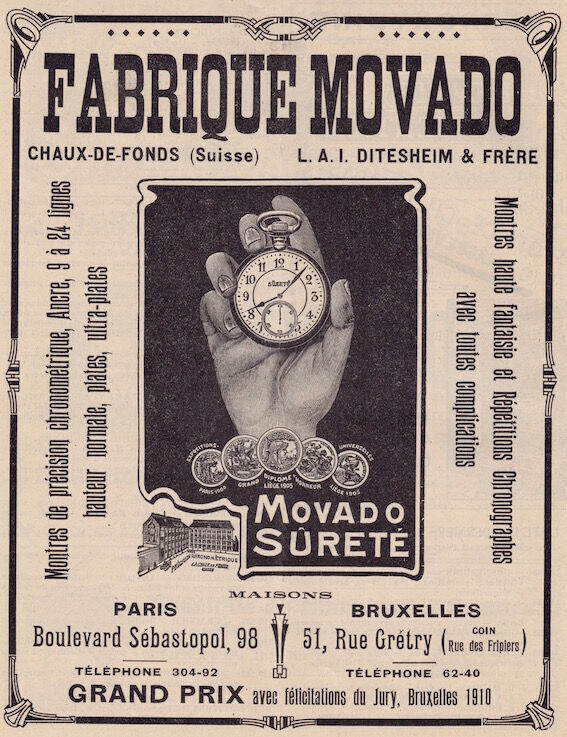
The brand was founded in 1881 in La Chaux-de-Fonds by Achille Ditesheim. In 1892, he joined forces with his brothers Léopold and Isidore to create L.A. & I. Ditesheim, Fabricants. In 1905, the company adopted the name Movado, meaning “always in motion” in Esperanto.
Movado stood out with creations such as the Polyplan (1912), with a calibre built on three inclined planes, the Curviplan (1920s), the Ermeto pocket watch (1926) with sliding case, and the iconic Museum Watch (1947), with its minimalist dial and single dot at 12 o’clock. Other highlights include the Chronoplan, Curvex, Astronic, Datron, and the link with the legendary El Primero.
In 1938, Movado introduced the calibre 90M, a modular two-register chronograph. In 1939, the 95M followed, adding an hour counter. These calibres are notable for their inverted pusher configuration: the lower button starts/stops the chronograph, while the upper one resets — the opposite of the usual layout.
Frequently cased in waterproof François Borgel (FB) cases, especially the Sub-Sea Chronograph, the 95M (or M95) was produced in fewer than 20,000 examples between the 1940s and 1970s. Their rarity, reliability, and unique architecture make them highly collectible today.
The 90M and 95M calibres remained in production until 1969, when Movado launched the Datron HS 360, powered by the famous El Primero. These chronographs reflect a balance of technical innovation and refined design, and remain milestones in Swiss watchmaking history.
Note: Movado also shaped watchmaking history with the Polyplan, Curviplan, Chronoplan, Curvex, Astronic, Datron and its connection to El Primero.


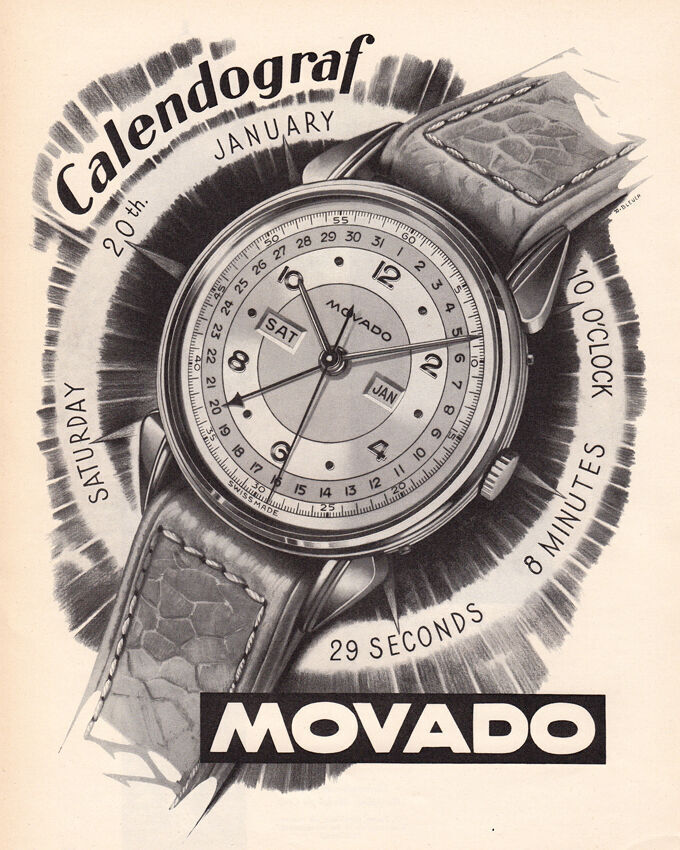

A La Clinique Horlogère
Rue du Creugenat 29
2900 Porrentruy
Tél +41 32 466 14 86
info@cliniquehorlogere.ch
