
The Beginnings of Citizen
The story of Citizen begins in 1918 in Tokyo, with the foundation of the Shokosha Watch Research Institute. In 1924, the first watch bearing the Citizen name appeared, its name suggested by the mayor of Tokyo, Shinpei Gotō. The idea was clear: to offer a quality watch accessible to every citizen. In 1930, Citizen Watch Co., Ltd. was officially established. The Swiss watchmaker Rodolphe Schmid, who had settled in Japan, contributed to the company’s early technical and industrial developments.
Japanese Innovation Before Chronographs
Over the decades, Citizen multiplied its innovations. In 1959, the Parawater became the first Japanese water-resistant watch. In 1966, the Cosmotron marked the beginning of the electronic balance-transistorized watch era. Then, in 1970, the X-8 Chronometer became the world’s first titanium watch. These achievements paved the way for a decisive milestone: Citizen’s entry into the automatic chronograph field.
The Arrival of Citizen Chronographs
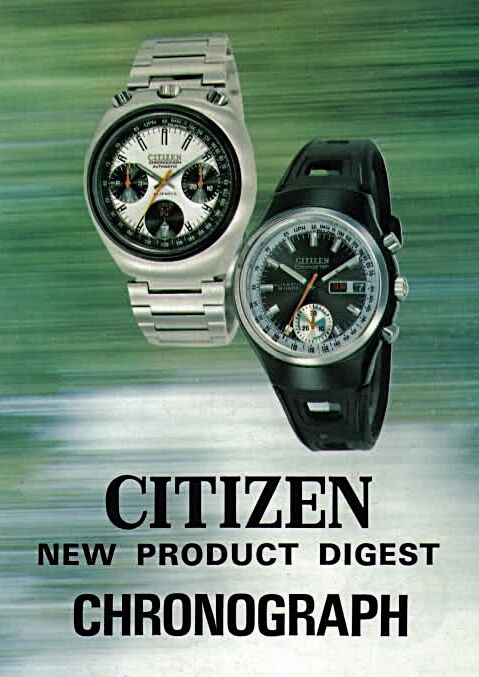
In 1972, Citizen unveiled its first automatic chronograph movement: the caliber 8100. The following year, the Challenge Timer Chronograph popularized this breakthrough. The 8100 stood out for its single-minute counter, while the more advanced 8110 added an hour counter and remains the most sought-after today.
Technically, these movements were impressive for their time: 28,800 vibrations per hour, column wheel, vertical clutch, and flyback function – features usually found only in high-end Swiss chronographs. Their robustness and accuracy made them legendary models.
Iconic Models
The Bullhead (1973–1977)
Citizen advertisement, 1974, Auto Motor und Sport magazine (Germany), presenting several references equipped with the 8110 caliber.
Among the most famous watches powered by the 8110 caliber, the so-called “Bullhead” holds a special place. With its pushers positioned at the top of the case (at 12 o’clock), it has an unmistakable silhouette. The Citizen 67-9011 Bullhead is perhaps the most iconic, produced in several dial variants, including the famous “Panda.”
The Octagonal Bullhead (1975)
Citizen Octagonal Bullhead, ref. 67-9356, advertisement and catalogue, mid-1970s.
Another notable model is the Citizen Octagonal Bullhead (ref. 67-9356), recognizable by its octagonal steel case. With its angular design and fine finishing, it perfectly embodies the spirit of the 1970s.
The “TV Screen” (1974)
Citizen 8110A “TV Screen,” ref. 4-901070Y, 1974 advertisement.
In 1974, Citizen also launched models nicknamed “TV Screen” because of their rectangular case, reminiscent of television screens of the time. Reference 4-901070Y is a remarkable example, also powered by the 8110 caliber.
The Single-Counter 8100 (1973–1974)
Citizen 8100A single-counter, ref. 67-95xx, 1973–1974 catalogue.
Finally, the 8100 caliber was used in more understated single-counter watches, such as the 67-95xx references. These models are now sought after by discerning collectors.
A Lasting Legacy
These Citizen chronographs of the 1970s are not just timepieces: they embody Japan’s ambition to rival the Swiss in precision and innovation. Their bold designs, combined with remarkable technical architecture, explain why these watches are still collected, worn, and admired today.
Who Was Rodolphe Schmid?
The Swiss watchmaker who gave Citizen its industrial roots
Born in Neuchâtel in 1871, Rodolphe Schmid settled in Yokohama in 1894. He began as a simple importer of Swiss watches, but, faced with rising customs duties, he quickly decided to manufacture locally. As early as 1908, he assembled movements imported from Switzerland, and from 1913 onward, he also produced cases in his Tokyo workshop. By the 1920s, his factory employed nearly 200 people, making it the second-largest watch producer in Japan at the time, behind Seikō (Hattori).
In 1918, alongside the creation of the Shokosha laboratory, Schmid registered the “Citizen” trademark in Switzerland for watches destined for the Japanese market. The name was later adopted and supported by the mayor of Tokyo, Shinpei Gotō, who believed that a “Citizen” watch should be within reach of every citizen.
In 1930, the management of Schmid’s factory, led by Yosaburō Nakajima, acquired Shokosha: thus, Citizen Watch Co., Ltd. was officially born. Schmid’s contribution was crucial: machine tools imported in 1933, movement blueprints drawn by a Geneva engineer in 1934, and technology transfers through Star Shokai (the Mido importer, integrated into Citizen in 1932). Unsurprisingly, the first Citizen models borrowed many design features from Mido watches of that era.
Schmid returned to Switzerland in the mid-1930s but remained a shareholder in Citizen until 1945. He passed away in 1959, leaving behind a foundational role: without his network, his machinery, and his Swiss expertise, Citizen would not have acquired such a solid industrial base so quickly.
Sources & Références
Citizen Japan Official Website: History Timeline (Cal.8100 – 1972)
Citizen Global Official Site: Historical Milestones (Challenge Timer – 1973)
Publicité Citizen 1974 (Auto Motor und Sport, Allemagne)
Worn & Wound – Citizen 8110 Octagonal Bullhead Review
Vintage Citizen / Sweephand Blog – Calibres 8100 & 8110
Service Manuals et livrets Citizen des années 1970

A La Clinique Horlogère
Rue du Creugenat 29
2900 Porrentruy
Tél +41 32 466 14 86
info@cliniquehorlogere.ch
