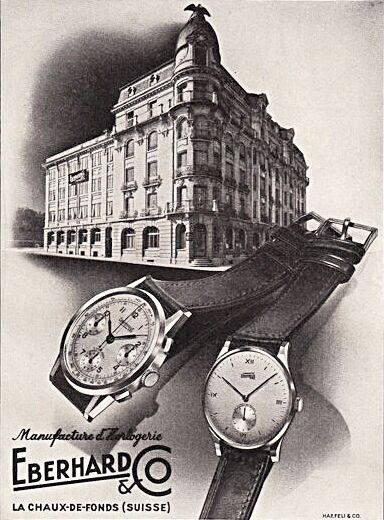
The company was founded in La Chaux-de-Fonds in 1887 under the name Eberhard et Rosselet, by Georges-Lucien Eberhard (from Jegenstorf, BE) and Henri Rosselet (from Douanne/Twann). In 1892, the firm became Eberhard & Co., and in 1906 it moved into the spectacular Maison de l’Aigle (73 Avenue Léopold-Robert), crowned with an eagle and combining workshops and housing.
These milestones set Eberhard’s technical DNA and explain its popularity with officers – particularly Italians – in the 1930s.
The name Extra-Fort appeared in the early 1940s and became the signature of the brand’s great chronographs. “Pre-Extra-Fort” and Extra-Fort pieces are recognizable by their sliding device on the right side (a lever to lock/pause the chronograph) – a very Eberhard idea to prevent accidental operations.
Movements:
Note: some dealers describe the 14000 as “in-house,” but specialist literature points out that Eberhard’s first true modern manufacture movement would only appear much later (EB 140 in 2019).
The caliber 1600 (without the two zeros) is linked to the split-seconds chronographs of the late 1930s and described as a modified Valjoux 65; while the 16000 was another major 16-ligne base of the period. Both designations sometimes overlap in auction listings, which explains the confusion.
After relocating to Biel/Bienne in 1978, the brand returned to its Maison de l’Aigle in 2018 and inaugurated its museum in 2019 – the eagle regained its dome.

A La Clinique Horlogère
Rue du Creugenat 29
2900 Porrentruy
Tél +41 32 466 14 86
info@cliniquehorlogere.ch
