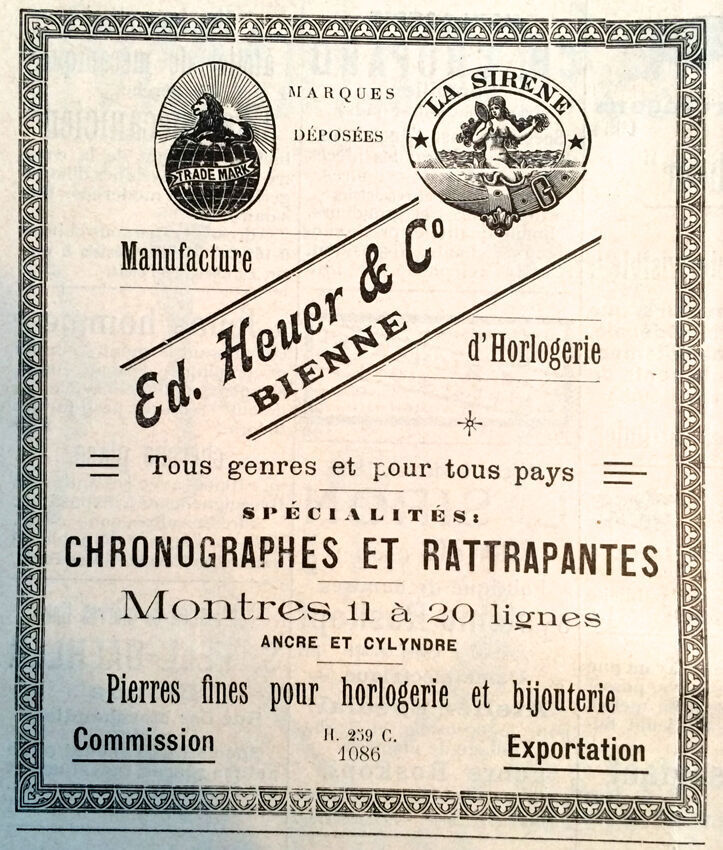
1902

Ed. Heuer & Cie was founded in 1860 by Édouard Heuer in Saint-Imier. In 1869 he patented his first keyless winding system. After a brief stay in Brugg, the company settled permanently in Biel/Bienne in 1867.
By 1876, Heuer had opened a London branch.
In 1887, Heuer patented the oscillating pinion, a system still used today in many chronographs.
Period advertisements highlight this specialty: “Chronographs and Split-Seconds”. Notable innovations include the Time of Trip (1911) and the Mikrograph (1916).
After Édouard, sons Jules-Édouard and Charles-Auguste took over. Later, Jack Heuer modernized the brand. In the US, the Heuer Time Corporation created unique collaborations (e.g. Abercrombie & Fitch).
In 1969, Heuer teamed up with Breitling, Hamilton-Büren and Dubois-Dépras. The Calibre 11 was launched simultaneously in Geneva and New York on March 3, 1969.
Heuer is remembered for its innovations and chronograph culture. The name remains synonymous with precision, sport and avant-garde spirit.

A La Clinique Horlogère
Rue du Creugenat 29
2900 Porrentruy
Tél +41 32 466 14 86
info@cliniquehorlogere.ch
