Le Phare (Manufacture in Le Locle)
In 1867, Charles Barbezat-Baillot partnered with Henry Guye under the name “Guye & Barbezat”, on rue de la Côte.
They produced complicated watches, chronometers, chronographs and repeater watches.
Henry Guye died in 1877. The company name then changed to “C. Barbezat-Baillot” and the manufacture became “La Locloise”.
In 1889, a patent was filed for a regulator for repeater watches that made the firm famous, as this system was much quieter than those of its competitors.
The company also registered several trademarks: “La Locloise”, “L’Espérento” (1900), “Tempora”, “Le Phare” (1897) and “Volapük” (1900).
Thanks to simplified calibres and high production, the firm enjoyed remarkable prosperity.
In 1896, the company won the gold medal at the National Exhibition in Geneva. The same year, Barbezat-Baillot registered the “Mignonette” trademark for ladies’ repeater watches.
In 1900, the firm won the Grand Prix at the Paris Exposition Universelle, and again in 1906 at the Milan International Exhibition.
Around 1903, it adopted the name “Manufacture d’Horlogerie Le Phare”.
In 1910, the company’s engineer, Perrenoud-Jacot, developed a method for manufacturing more precise automatic machines for producing watch movement parts. These were built in-house under the name “Dixi”. Thanks to this in-house machine production, watchmaking became less expensive and less privileged clients could also afford repeater watches.
In 1914, both companies were acquired by Georges Perrenoud fils, head of the eponymous assortments factory. During World War I, the firm was requisitioned by the federal military administration and converted into a factory for military trousers. Deeply dissatisfied, Barbezat-Baillot sold his watch manufacture to Zenith in 1915. The new owner did not change the production focus.
Under Zenith, the company produced chronographs with and without flyback, medical watches (for pulse measurement), tachymeters, production counters and, of course, repeater watches in standard and chronometer quality, as well as 8-day movements. Calendar clocks were also made. Meanwhile, “Dixi” enjoyed great success in the market for workshop equipment.
In 1920, the company continued to make chronographs and repeater watches.
Other manufacturers purchased movements or ébauches for their own brands, including Audemars Frères, Zenith, Movado, Henri Sandoz, Armand Nicolet, Vulcain and Angelus.
In 1922, Zenith sold “Le Phare”, which became independent again. A relocation followed to benefit from larger premises: the company moved to La Chaux-de-Fonds and traded as “Nouvelles Fabriques Le Phare SA, La Chaux-de-Fonds”. “Dixi” remained in Le Locle as a precision-machine manufacturer.
The company exhibited at the Basel Fair in 1949. It produced and developed chronographs and repeater wristwatches, as well as sports chronometers, becoming the second-largest maker in this segment. The brand, however, remained largely unknown because most watches were sold under private label. The product range expanded to calendar wristwatches with and without moon phase, with and without automatic winding, as well as water-resistant models. New trademarks were launched: “Alikor” and “Maple”.
The firm was renamed “Le Phare – Sultana SA” in 1974. By then the market for mechanical chronographs had collapsed during the quartz crisis. The company survived by creating exclusive, innovative models launched under the “Jean d’Eve” brand. Notable creations included “Spinnacker” (strap made from genuine marine cable), “Blue Marlin” (gimbal suspension), “Upside Down” (clasp integrated into the case), “Aéroport” (five time zones), “Sectora” (sector-display hours over 130°) and “Quarta”. The “Samara” was particularly ingenious: an autoquartz system with an accumulator instead of a battery.
Today, the company belongs to “Renley Watch Mfg. Co. Ltd., Hong Kong”.
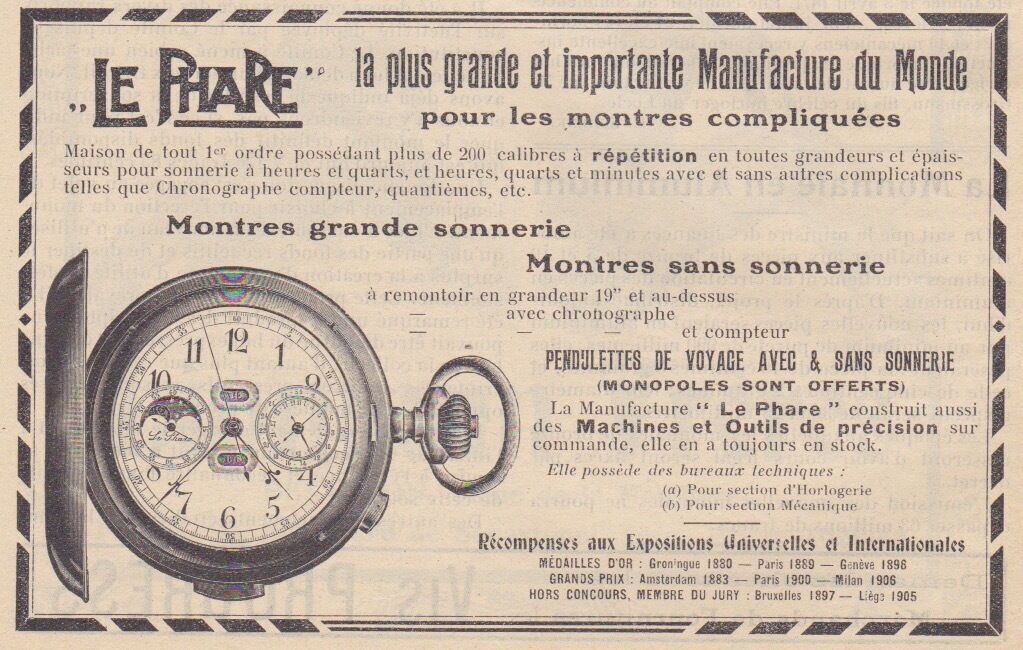
Publicité de 1909
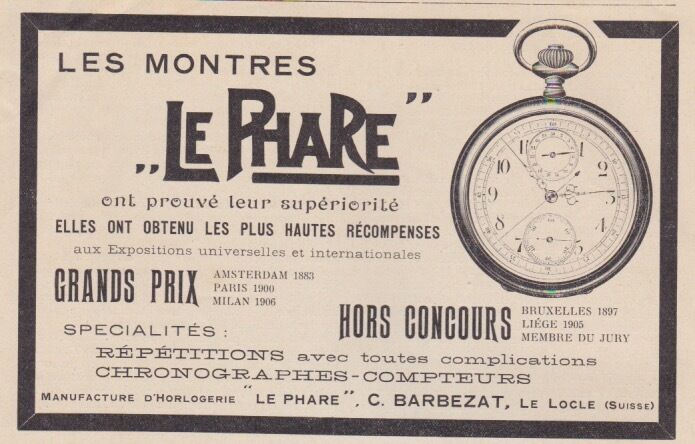
Publicité de 1913
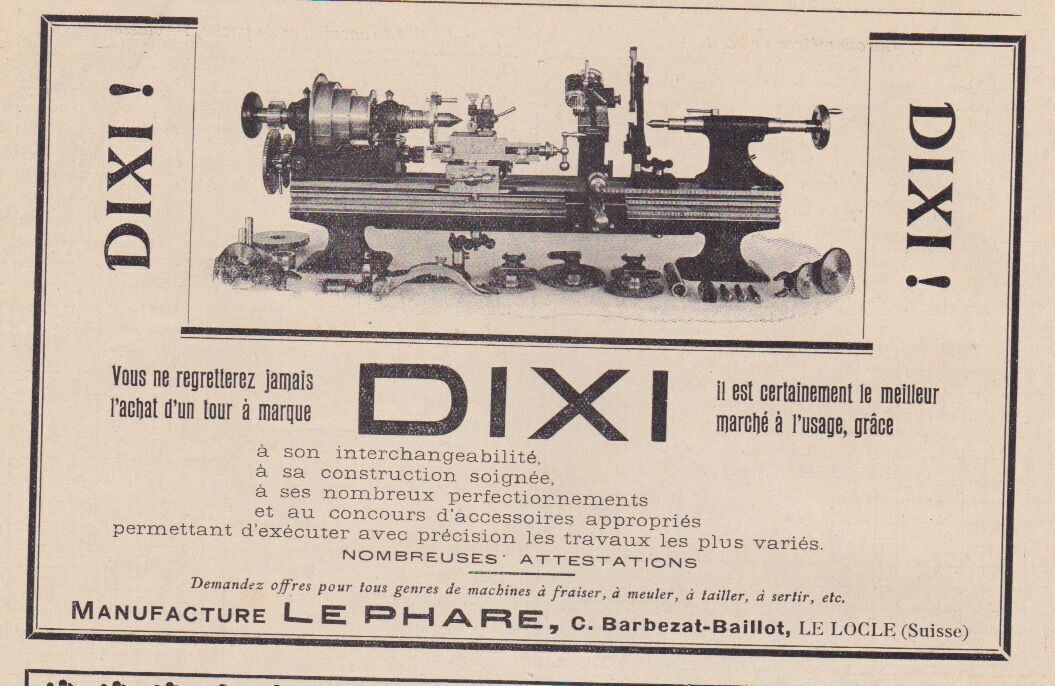
Publicité de 1913


