


From Kintarō Hattori to the Speedtimer
In 1881, in the heart of Tokyo’s Kyōbashi district, Kintarō Hattori opened his watch business, K. Hattori & Co. He quickly took a decisive step forward by founding his own factory, Seikōsha (“House of Precision”), with the ambition of giving Japan a truly modern watchmaking industry. In 1924, the name Seiko appeared for the first time on a dial, marking the beginning of an identity now recognized worldwide.
Sports Timing as a Showcase
From the 1960s onwards, Seiko established itself in the field of sports timekeeping. As the official timekeeper of the 1964 Tokyo Olympic Games, the brand developed reliable instruments that laid the foundations of its international reputation. At the 1972 Sapporo Winter Olympics, Seiko innovated again with a system combining electronic and manual timing, designed to meet the demands of live television.
A brochure of the time underlined: “Seiko, the timekeeper of a new era”, highlighting the Japanese brand’s determination to compete with the Swiss on a global scale.
1969: The Race for the First Automatic Chronograph
The spring of 1969 marked a decisive turning point in watchmaking history. Three contenders claimed the title of the first automatic chronograph: Zenith with the El Primero, the Heuer–Breitling–Hamilton/Büren consortium with the Chronomatic (Caliber 11), and Seiko. The Japanese brand launched the Speedtimer with the 6139 caliber, an integrated movement with a column wheel and vertical clutch—an architecture that would become a hallmark of Japanese chronographs.
In a 1969 advertisement, Seiko proudly stated: “A new standard in speed and accuracy”. While debates about primacy continue, historical records confirm that the 6139 was already available in Japan by May 1969.
The 6139 and 6138 Calibers
The 6139 caliber was the foundation: a 30-minute counter at 6 o’clock, bilingual day/date display, recessed crown, and one remarkable feature—the absence of manual winding, as the watch was exclusively automatic. With a frequency of 21,600 vibrations per hour and a robust column wheel, it combined simplicity with technical efficiency.
The 6139-600X versions, with their two-tone (red/blue) rotating bezel, soon became iconic. A 1970 Japanese catalog described them as: “Speed-Timer, for men who move faster”. One such model, the 6139-6005, entered history when astronaut William Pogue wore it during the Skylab 4 mission (1973–1974): the very first automatic chronograph in space.
The 6138 caliber appeared in the early 1970s. More advanced, it featured two registers (minutes and hours), manual winding in addition to automatic, while keeping the column wheel and vertical clutch. Its architecture gave rise to models with distinctive aesthetics: the square-cased “Kakume,” the highly collectible “Panda/Baby Panda,” and the “Calculator” with its integrated slide rule. A 1972 leaflet emphasized their vocation as “Professional chronographs for science, sport and speed”.
The Speedtimer Universe: Racing, Aviation and Cultural Impact
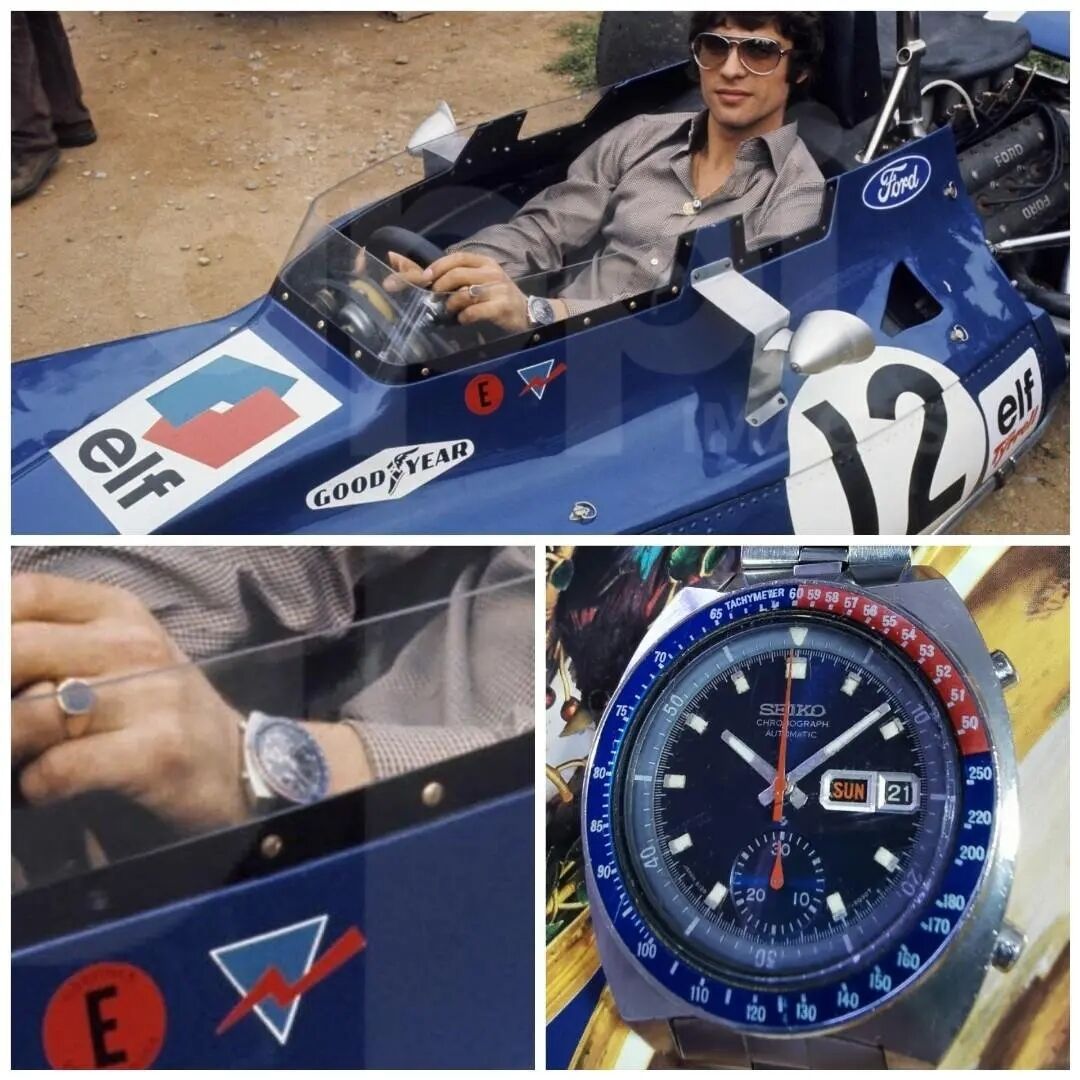
The Speedtimer also owes its reputation to its adoption in fields where precision was essential. On the racing circuits of the 1970s, it was worn by drivers such as François Cevert, rising star of Formula 1, and Tetsu Ikuzawa, one of the first Japanese drivers recognized internationally. Images of these figures with their Seiko chronographs were widely circulated in magazines and advertising campaigns, anchoring the Speedtimer in the world of motorsport.
In aviation, archival documents confirm that some “SpeedTimer” dials were worn by members of the Japan Air Self-Defense Force (JASDF). This association reinforced the watch’s image as a reliable professional instrument, capable of meeting the requirements of military pilots.
Finally, the “Pogue” cemented Seiko’s place in space history. A late-1970s American advertisement echoed this achievement: “Tested in orbit, trusted on Earth.”
From Heritage to Prospex Re-editions
These multiple legacies—sport, automotive, aviation, and space—explain why the Speedtimer remains one of the most collected chronographs today. Its 1970s design, combined with robust technical architecture, has earned it a unique place in horological history.
The modern Prospex Speedtimer collection continues this tradition. Inspired by the 1969 models, the re-editions retain the same philosophy: precision, readability, and reliability. A recent Seiko slogan sums it up: “Born in 1969, reborn for today.”
References and Sources
Seiko Museum Ginza – Official history of Seiko and the 6139 caliber (Tokyo, Japan).
William R. Pogue – Testimony (2006) and Heritage Auction (2008) of his Seiko 6139-6005 worn during Skylab 4.
Seiko Catalogs 1970–1972 – Presentation of the Speedtimer 6139/6138 and period slogans.
Auto Motor und Sport (1974) – Watch advertisements linking chronographs and motorsport.
The Road Rat Magazine, No. 3 (2019) – Article on François Cevert and his Seiko 6139.
Archives and testimonies on Tetsu Ikuzawa – Connections between the Speedtimer and Japanese motorsport (1970s).

A La Clinique Horlogère
Rue du Creugenat 29
2900 Porrentruy
Tél +41 32 466 14 86
info@cliniquehorlogere.ch
