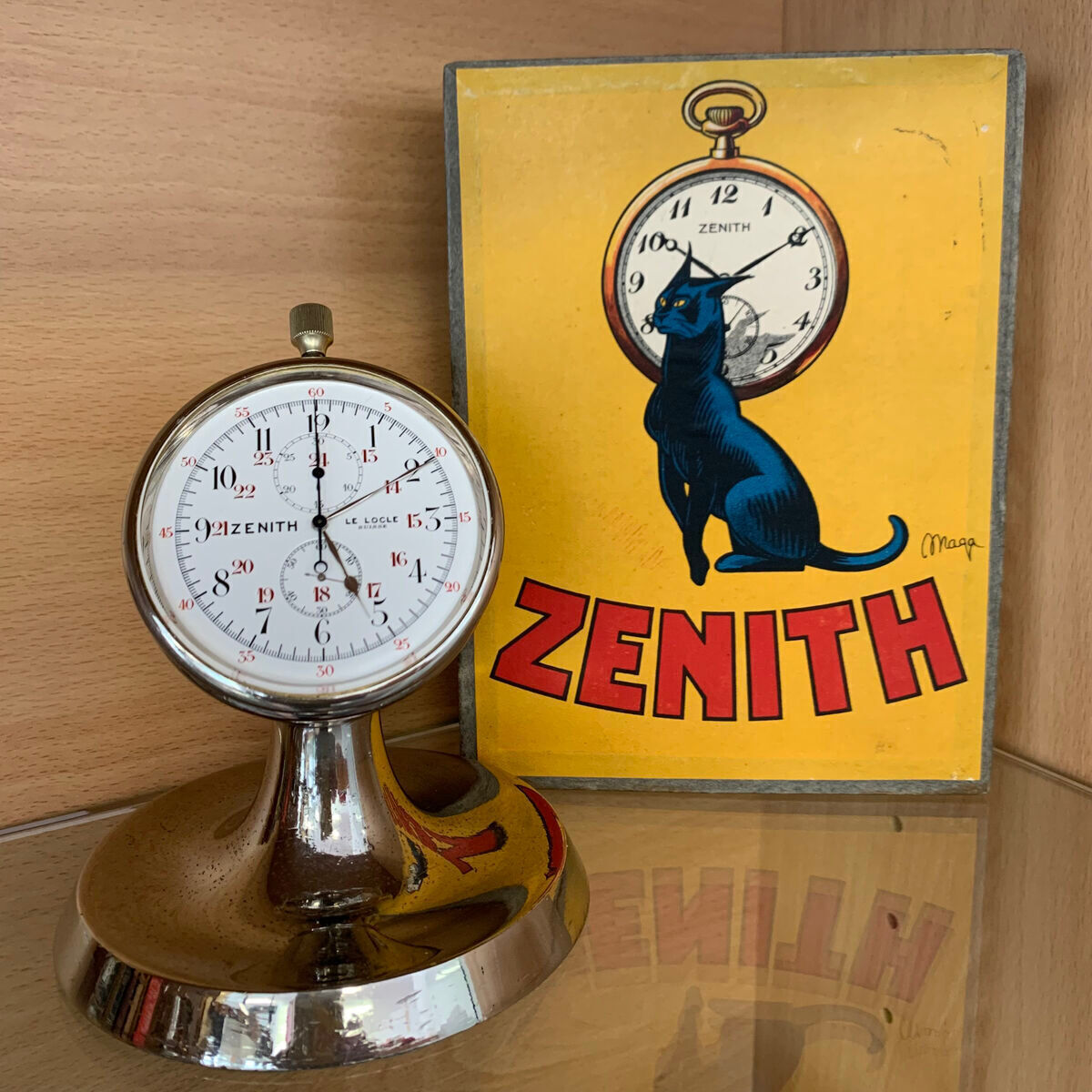
Founded in 1865 in Le Locle by Georges Favre-Jacot, the Zenith manufacture soon became a pioneer of the integrated manufacture concept, bringing together all the essential watchmaking professions under one roof. Renowned for precision and chronometry awards, the brand gradually developed complex mechanisms, paving the way for the creation of chronographs.
Zenith’s first chronographs appeared in the early 20th century. Their cadrature mechanism — the part controlling the minute counter — was devised by the watchmaker and inventor César Racine. On May 5, 1909, Racine filed a patent for a jump-minute chronograph counter (Swiss patent CH 46868A, published in 1910). This design allowed the minute counter to advance precisely by one step each time the chronograph seconds hand returned to zero, ensuring an instantaneous and accurate reading.
This mechanism powered the Zenith 19-ligne calibre — a 41.2 mm chronograph movement, 6.8 mm thick, beating at 18,000 vph, dated around 1910. Several versions were used in pocket chronographs, such as the Postal Service model (1930) or teaching instruments from the Technicum du Locle.
César Racine (Le Locle, late 19th – early 20th century) was a creative horologist and mechanic, specializing in striking and repeater systems. His research led to several major improvements in the design of chronograph and chiming mechanisms.
Notable Swiss patents include:
With this last patent, Racine provided Zenith with the technical foundation for its first industrial chronographs: a robust architecture, precise reset system, and synchronized minute counter display. These advances paved the way for professional pocket chronographs produced from the 1910s to the 1930s.
In the late 1950s, Zenith acquired the Martel Watch Co. of Le Locle, renowned for its chronograph movements. This acquisition marked a return to full in-house production and enabled an ambitious project: to create a high-frequency integrated automatic chronograph to celebrate the manufacture’s centenary (1865–1965).
On January 10, 1969, Zenith unveiled the Calibre 3019 PHC, better known as the El Primero — the first integrated automatic chronograph beating at 36,000 vph. This high frequency allowed time measurement to one-tenth of a second. Its compact architecture and central rotor made it one of the most celebrated movements of the 20th century.
The El Primero became the foundation for multiple variations: tenth-of-a-second displays (Striking 10th), double escapement hundredth-of-a-second versions (Defy 21), and models featuring moon phase or perpetual calendar (calibres 400, 400Z, 4003).
During the 1970s quartz crisis, mechanical production was halted. Watchmaker Charles Vermot secretly saved the El Primero blueprints, tools, and parts by hiding them in the attic of the manufacture. Thanks to his foresight, Zenith was able to relaunch the calibre in the 1980s. In 1988, Rolex adopted a modified El Primero movement for its Daytona automatic chronograph — restoring Zenith’s prestige and ensuring its future. The company later joined the LVMH group in 1999.
From the early jump-minute pocket chronographs inspired by César Racine to the modern El Primero line, Zenith has maintained an unbroken tradition of innovation. Its mastery of short-time measurement, integrated manufacture culture, and dedication to precision make it one of the great names in Swiss chronograph history.
Note: This overview traces Zenith’s chronograph evolution — from César Racine’s jump-minute pocket mechanisms of the early 1900s to the high-frequency El Primero. It highlights Racine’s pioneering role in early chronograph architecture and the technical lineage that culminated in the 3019 PHC calibre.

A La Clinique Horlogère
Rue du Creugenat 29
2900 Porrentruy
Tél +41 32 466 14 86
info@cliniquehorlogere.ch
