Longines — Chronographs and Sporting Spirit
Foundation and identity
The house of Longines was founded in 1832 in Saint-Imier by Auguste Agassiz, under the name Agassiz & Co. In 1867, it adopted the name Longines and its famous winged hourglass logo — the oldest still in use in watchmaking.
First steps in timekeeping
In 1878, Longines introduced its first chronograph, the Calibre 20H, a monopusher design quickly adopted in horse racing. That same year, the brand began its long history in sports timekeeping, particularly in the United States.
Technical evolution and pioneering role
In 1912, the manufacture revolutionized sports timing with electrical wire triggering, foreshadowing modern synchronization systems. In 1913, Longines created the Calibre 13.33Z, one of the first wrist chronographs, with a crown-integrated pusher. This model also introduced the flyback function, patented in 1935 and registered in 1936.
The 13ZN: a chronograph legend
In 1936, Longines launched the Calibre 13ZN, considered one of the finest wrist chronographs of its time. It featured flyback capability and a semi-instantaneous minute hand, highlighting the brand’s technical leadership. Today, watches powered by the 13ZN are highly prized by collectors.
Civil and sports chronographs
Alongside civilian production, Longines excelled in sports timekeeping. By 1886, its 20H chronograph was used at horse races, and in 1912, the company became official timekeeper at equestrian events. This tradition continues: Longines is now partner of major competitions such as the FEI, Global Champions Tour, and Royal Ascot.
Heritage and modernity
Longines chronographs, especially those with the 13.33Z and 13ZN calibres, hold a special place in horological history. They embody robustness, precision, and elegance. The brand preserves this heritage through its Heritage Collection, reissuing iconic models, and through modern creations such as the Chrono Flyback and the Spirit line, inspired by its aviation past.
Sources
- Longines — Official site & Heritage Magazine
- Swatch Group — Longines presentation
- Watch-Wiki — Longines, Calibres 13.33Z & 13ZN
- Hodinkee — History of the 13ZN
- Grail Watch Reference — Flyback chronographs
- GQ Magazine — Longines Chronograph Legacy
- Veranda Magazine — Longines and equestrian sport
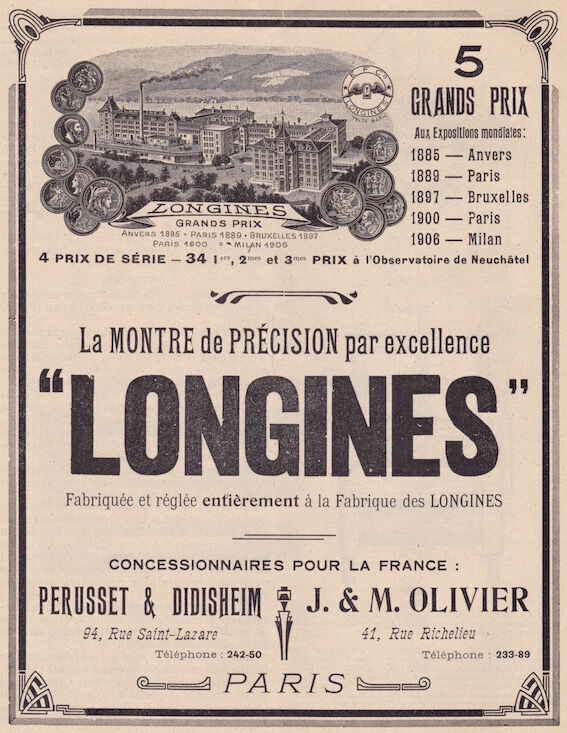
1910
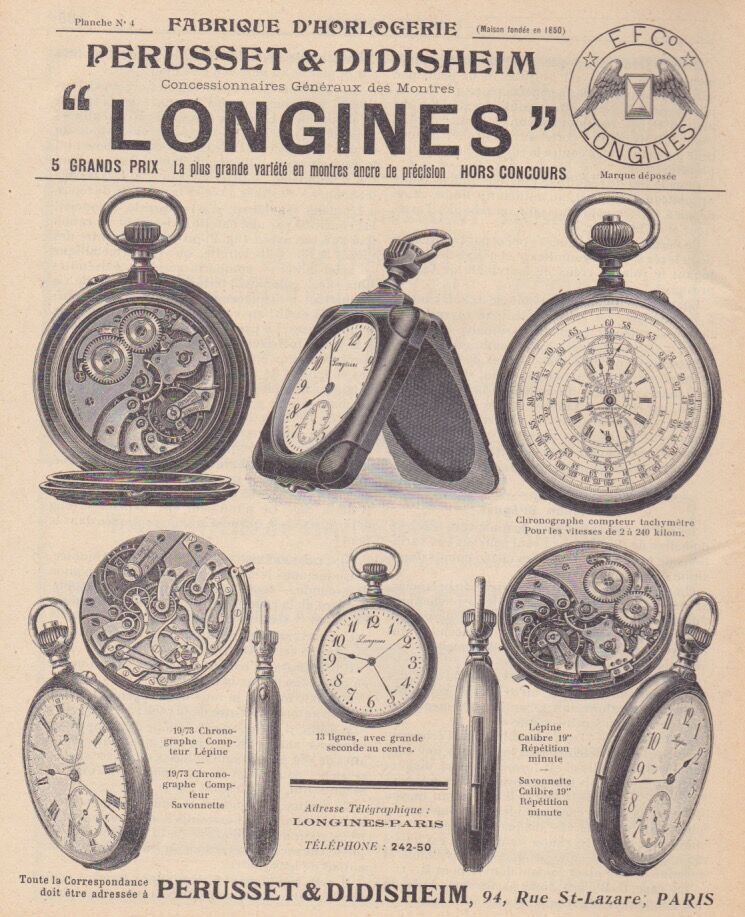
1911



