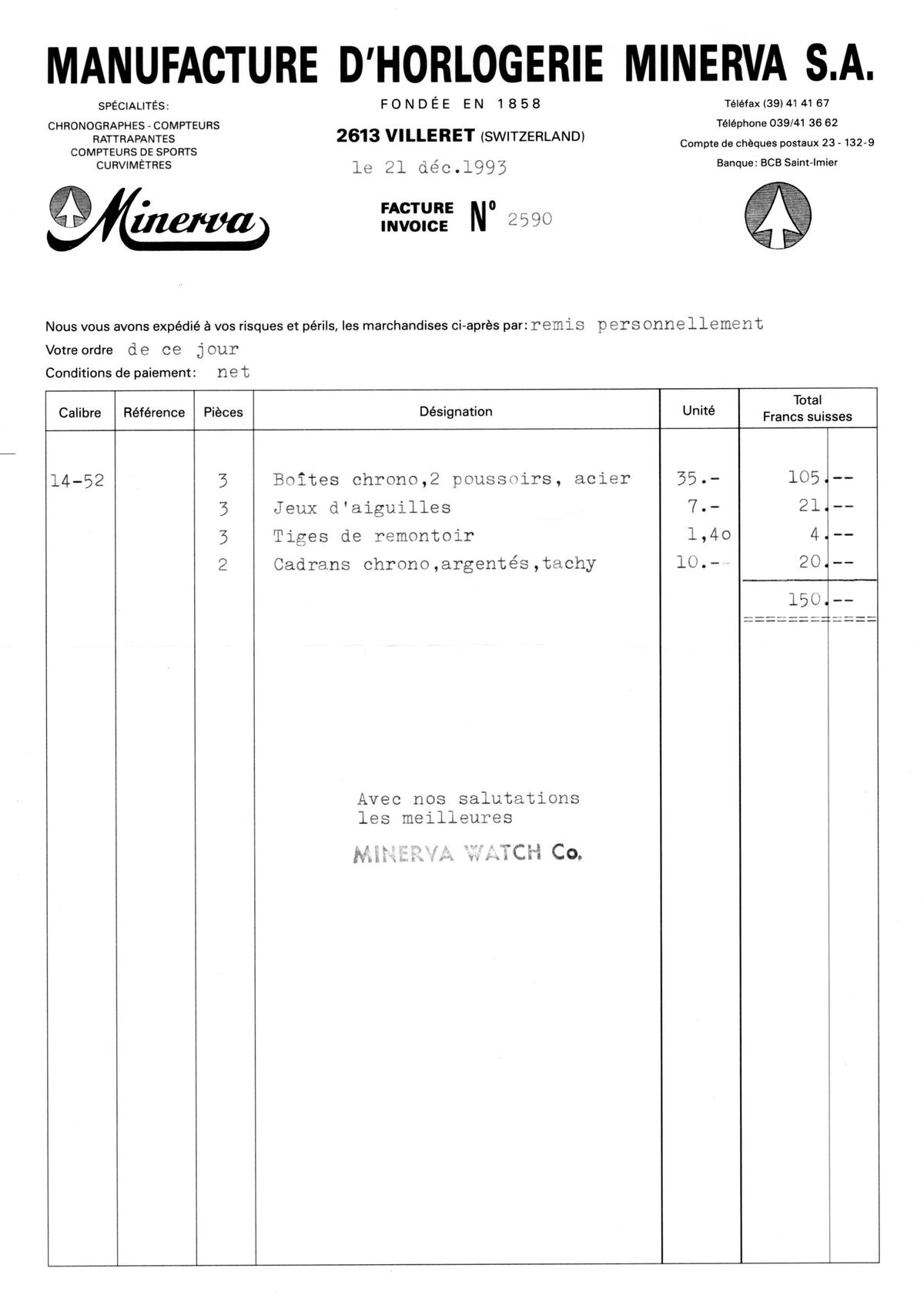

The story begins in 1858 in Villeret, in the Bernese Jura, with the founding of H. & C. Robert by brothers Charles-Yvan and Hyppolite Robert. Initially, the company worked as an établisseur, assembling watches from supplied components. In 1878, the next generation — Charles, Georges, and Yvan Robert — took over, renaming the company Robert Frères Villeret (RFV) and adopting the arrow logo.
To cover different markets and segments, RFV registered several brands: Mercure (1886), Minerva (1887), and later Ariana, Arval, Herta, Majex, Tropic (1898–1908). From 1895, RFV manufactured its own movements and cases, strengthening its independence.
In 1902, new factory buildings marked a turning point. Early in-house calibres included the 18-1 (cylinder escapement) and the 19-3 (lever escapement). In 1908, Minerva launched its first significant pocket chronograph, the 19-09 CH. By 1916, the manufacture offered a chronograph capable of measuring the 1/100th of a second, designed for motor racing and sporting competitions. In 1923, the name became Fabrique d’Horlogerie Minerva, Robert Frères SA, and in 1929, simply Minerva SA, Villeret.
In 1934, Minerva came under the management of Charles Haussener and Jacques Pelot. The company specialized in column-wheel chronographs, such as the 13-20 CH and 13-21, known for their robustness and precision. These calibres became benchmark pieces, highly sought after by collectors.
During the 1960s–70s, Minerva continued producing traditional chronographs while many competitors switched to quartz. This commitment to mechanical watchmaking ensured the brand’s survival, despite smaller production volumes. The Frey family remained in control until 1989.
Revived in 2000 by an Italian investor, the brand joined the Richemont Group in 2006. Since 2007, Minerva has become the Institut Minerva de Recherche en Haute Horlogerie within Montblanc, based in Villeret. Column-wheel chronographs, hand finishing, and the workshop spirit live on in the Villeret 1858 line and other haute horlogerie pieces.
From RFV to Minerva and into the Montblanc era, continuity of know-how is embodied in legendary movements: 19-09 CH, 13-20 CH, 13-21. Their precision, architecture, and finishing make them milestones for enthusiasts and collectors alike.
Note: The brands (Ariana, Arval, Herta, Majex, Mercure, Tropic) were used by RFV/Minerva to target different markets and ranges in the late 19th and early 20th centuries.

A La Clinique Horlogère
Rue du Creugenat 29
2900 Porrentruy
Tél +41 32 466 14 86
info@cliniquehorlogere.ch
