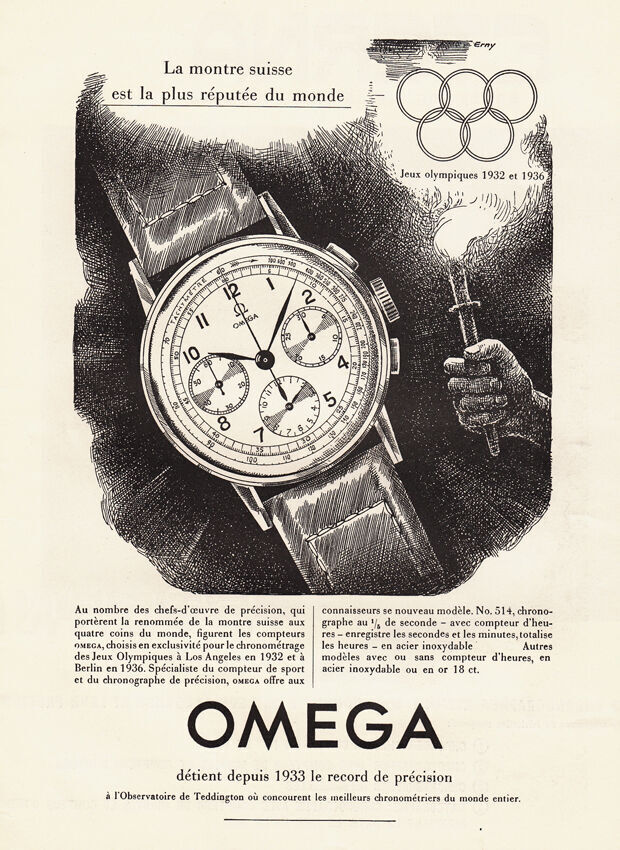
1944

In 1848, young watchmaker Louis Brandt opened a modest workshop in La Chaux-de-Fonds. He assembled watches from components supplied by local craftsmen, and soon found customers across Europe. After his death in 1879, his sons Louis-Paul and César modernized the business and moved production to Bienne.
In 1894, they developed the Omega 19-ligne calibre, precise and rational, designed for interchangeable parts. Its success was such that in 1903 the company adopted the name Omega Watch Co. in its honor.
In the early 20th century, Omega established itself in precision timekeeping. In 1932, it became the official timekeeper of the Los Angeles Olympic Games — a partnership that continues today. This sporting expertise also drove the development of wrist chronographs, a field where Omega excelled.
During the 1940s and 1950s, Omega produced robust military watches and reinforced its civil lines. The Seamaster (1948) introduced water resistance, while the Speedmaster (1957), originally designed for motorsport, quickly became the reference chronograph. It was powered by the Calibre 321, based on the Lemania 27 CHRO C12 column-wheel movement, renumbered under Omega’s own system.
Collaboration with Lemania — within SSIH — was decisive: most Omega chronographs from the 1940s to the 1990s were built on Lemania bases, though they bore Omega’s own calibre numbers (321, then 861 and 1861 for later Speedmasters).
In 1965, after extreme testing, NASA adopted the Speedmaster as the astronauts’ official watch. On July 21, 1969, it became the first watch worn on the Moon during Apollo 11. The “Moonwatch” entered legend as a symbol of reliability and endurance.
In the following decades, Omega broadened its reach: the Seamaster became the underwater explorer’s watch, and since 1995, the timepiece of James Bond; the Constellation stood for chronometric performance; the De Ville embodied classical elegance. Despite these successes, Omega was not spared by the quartz crisis that affected all Swiss watchmaking.
In 1999, Omega launched the Co-Axial escapement, invented by George Daniels and industrialized by the brand. By reducing friction, it improved rate stability and lengthened service intervals. It became Omega’s modern technical signature.
Since the 2000s, Omega has developed Co-Axial Master Chronometer calibres, certified by METAS and resistant to more than 15,000 gauss. This technical mastery, combined with vertical integration, secured Omega’s status as an innovative manufacture. Still based in Bienne within the Swatch Group, Omega continues to embody its icons — Speedmaster, Seamaster, Constellation, De Ville — writing its story at the intersection of heritage and 21st-century innovation.

A La Clinique Horlogère
Rue du Creugenat 29
2900 Porrentruy
Tél +41 32 466 14 86
info@cliniquehorlogere.ch
