
1938
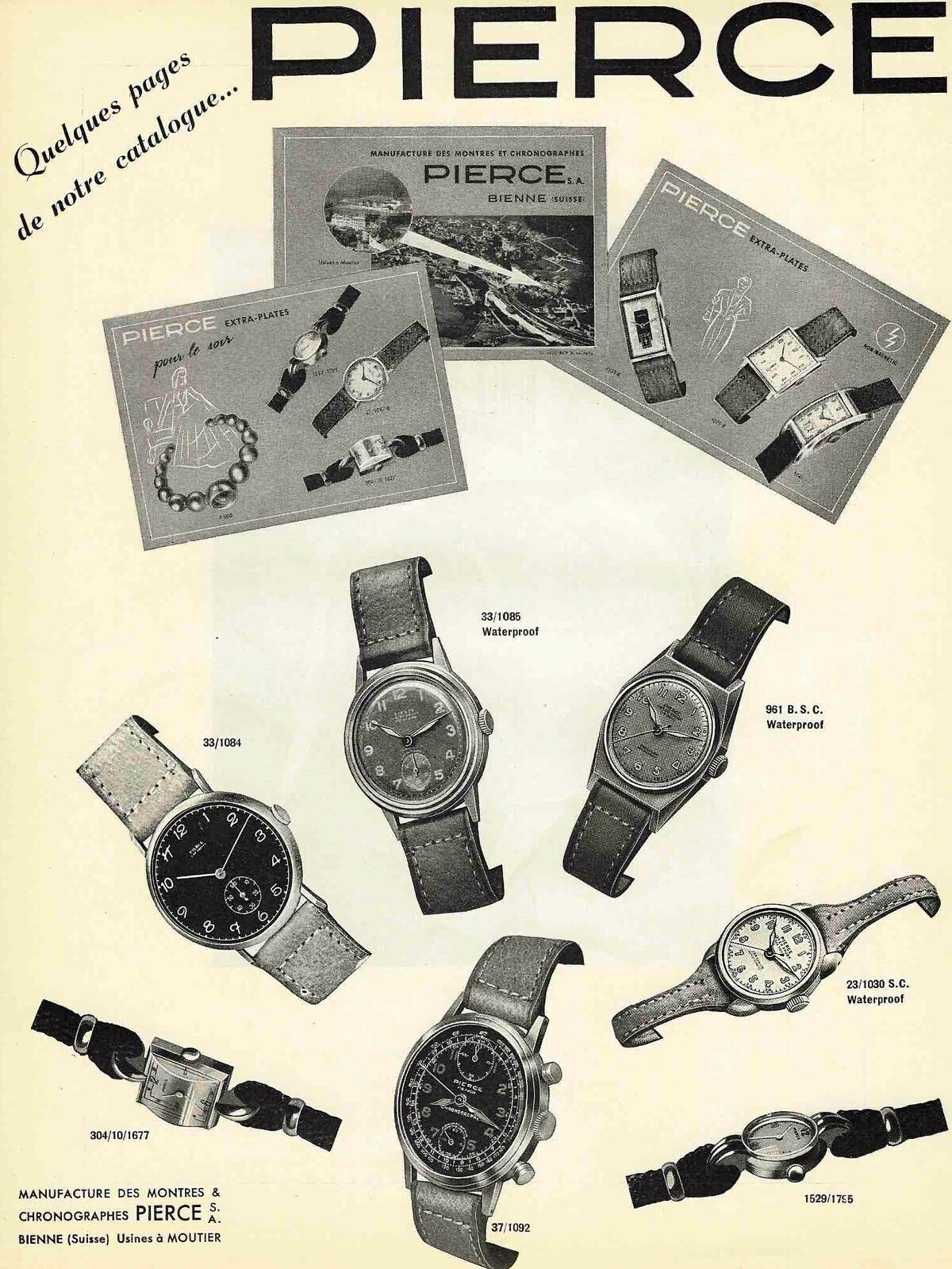
The history of Pierce goes back to 1883 in Bienne, when Léon Lévy and his brothers founded the workshop Léon Lévy Frères. The company grew quickly and expanded to Moutier, where a large factory was built in the early 20th century. From the outset, the house cultivated technical independence by developing its own movements rather than relying on outside suppliers.
In the early 1930s, the commercial name Pierce was adopted and exports expanded. The company invested in designing a fully in-house chronograph calibre, going against the trend of assembling external ébauches.
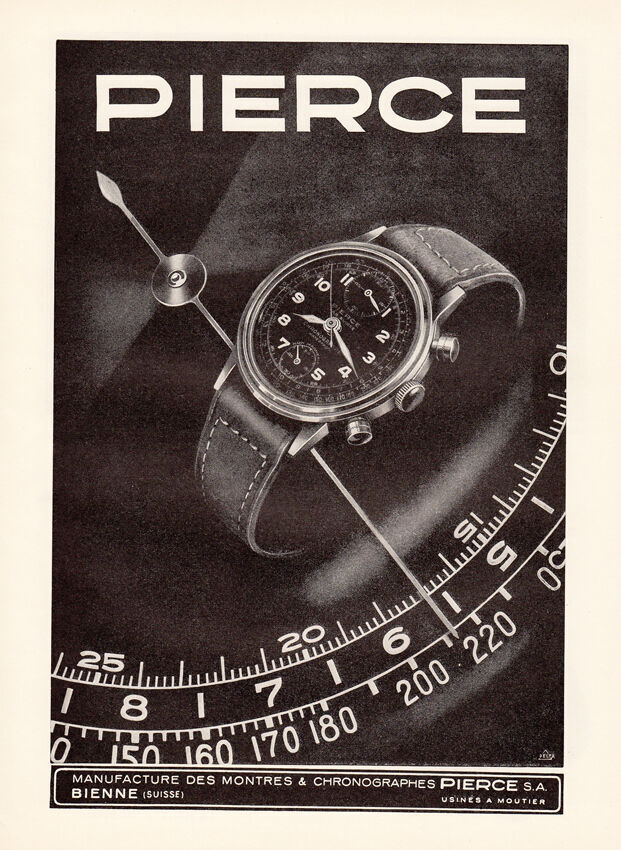
In 1935, Pierce introduced the Calibre 130, a robust, affordable chronograph equipped with a vertical clutch — a pioneering design in wristwatches at the time. In 1936, the company launched the Chronomatic, its emblematic chronograph, which popularized this calibre worldwide.
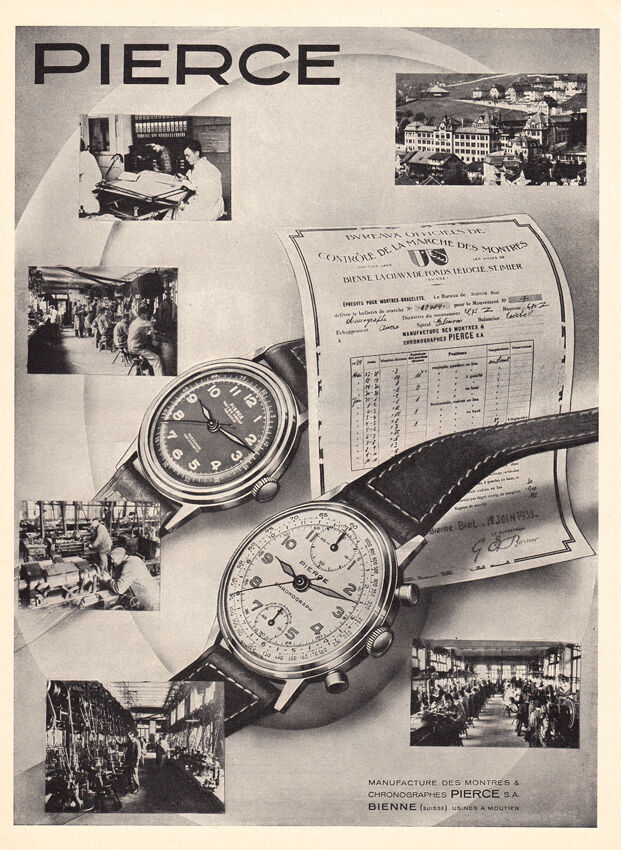
In 1938, the firm officially became Manufacture des Montres & Chronographes Pierce S.A.. It produced one- and two-pusher chronographs, pilot’s watches and utilitarian instruments for automobiles and aviation. Pierce’s hallmark was simple, efficient and reliable mechanics, designed for large-scale production.
The post-war years confirmed Pierce’s inventiveness: in 1955, the Correctomatic simplified date adjustment; in 1956, the Duofon introduced a mechanical alarm with two sound levels, indicated on the dial. In 1960, the Intercosmos reflected the brand’s taste for day/date complications and technical design.
Like many Swiss makers, Pierce was pressured by industrial changes from the 1960s onwards. The Moutier factory was eventually closed, yet its legacy remains: an in-house chronograph with vertical clutch that marked history for its functionality and price, along with practical innovations such as the Correctomatic and Duofon. The brand has seen revivals in the 21st century, with collections inspired by its archives.


A La Clinique Horlogère
Rue du Creugenat 29
2900 Porrentruy
Tél +41 32 466 14 86
info@cliniquehorlogere.ch
