
The Vénus SA Ébauche Factory was established in Moutier (canton of Bern) in 1924 (activity started in 1923) by the Berret brothers together with O. Schmitz, after acquiring the Victor Spozio factory. One year later, J.-B. Berret left and was replaced by Gasser & Co (watch jewels). Financial difficulties led Vénus to join Ebauches SA in 1928.
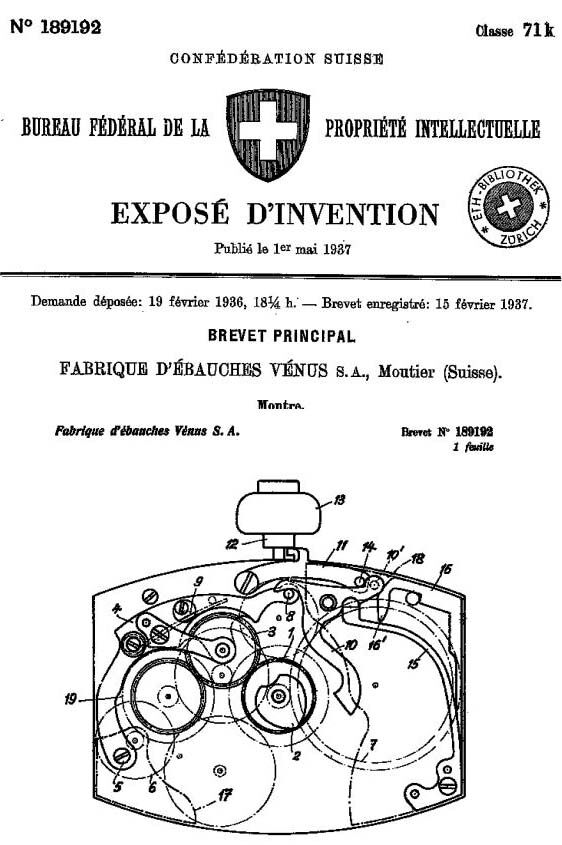
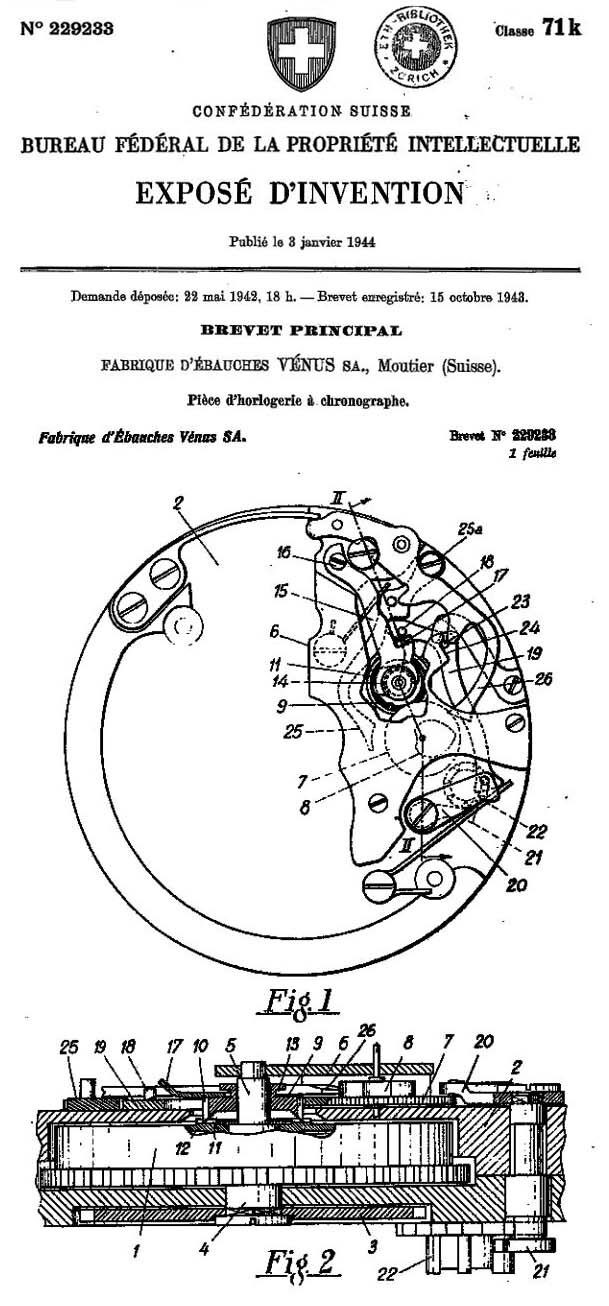
In 1933, Vénus filed a patent for a chronograph system. From 1935, the firm focused on chronographs, notably the Calibre 150 (copied in 1957 in the USSR for the Strela 3017). In the 1940s came the signature movements: the Cal. 175 (column wheel), produced into the 1960s, and the Cal. 178, adopted by Breitling, Minerva, Gallet, Leonidas, Zodiac, and others.
For more affordable models, Vénus introduced the cam-switched Cal. 188, engineered for simpler, lower-cost production—direct competition to Landeron.
The Cal. 150 inspired the Soviet Strela (from 1957). Around 1966–1967, Vénus sold a Cal. 175 production line to the Tianjin Watch Factory to supply military pilots; about 1,400 pieces were delivered to the People’s Liberation Army. In 2003, civilian production resumed as the Sea-Gull ST19.
In 1966, Vénus SA closed. Valjoux took over know-how and tooling: the Vénus 188 underpinned the Valjoux 7730 (then 7733/7734/7736), leading—through industrial continuity—to the iconic Valjoux 7750 automatic cam-switched chronograph.
Note: Vénus stock was commercialized by Jaquet SA (now Lajoux-Perret). In the 2000s, several brands (Maurice Lacroix, Panerai, Parmigiani, …) re-issued some movements (175, 179, 185). Breitling was among Vénus’ largest clients (many 1940s–1960s Premier and Navitimer with 175/178).
In the early 20th century, Vénus was also a watch brand owned by Schwarz-Etienne (La Chaux-de-Fonds, 1902), distinct from the Vénus SA ébauche factory in Moutier.
Though the company disappeared, Vénus remains a major historical name in chronograph ébauches. Cal. 175, 178 (column wheel) and 188 (cams) are among the 20th century’s most emblematic architectures. The Sea-Gull ST19 keeps that legacy alive.

A La Clinique Horlogère
Rue du Creugenat 29
2900 Porrentruy
Tél +41 32 466 14 86
info@cliniquehorlogere.ch
